Well fuck all this then?
My site sccl.cc has a whole history of optimizations.
First there was the migration from Astro to Zine - separate shitpost about that. Then squeezing everything into 1 RTT - already wrote a deep article on that.
tl;dr: the site is compressed to 13kb gzip, loads in a single TCP packet, one round trip for data.
So the site flies. But I wanted to add 88x31 badges.
You know, those tiny buttons everyone puts in their site footer. Like “Powered by something”, links to friends, clubs like 512kb.club and 14kb.club.
It’s web classics. How do you even live without them.
But there’s a catch: the site is optimized down to one request. And now you have a dozen badges, each 200++ bytes but each a separate HTTP request.
Gotta figure something out.
88x31: where it even came from
The 88 by 31 pixel format is one of the oldest web traditions.
It all started with Netscape. In 1996 they launched the “Netscape Now!” program - buttons you could put on your site to show you’re using their browser.
88x31, gray background, beveled edges, “Netscape Now!” text.
Then others picked it up. Microsoft with Internet Explorer. GeoCities for their users. Then “Best viewed in…”, “Powered by…” - off it went.
The browser wars era made these buttons ubiquitous. It was a way to show affiliation: I use this browser, I’m hosted on this platform, I’m in this webring.
Now the format is having a second birth. Neocities, indie web revival, all sorts of clubs (512kb.club, 14kb.club, no-js.club) - each has its own badge. And people are plastering them all over their sites.
neonaut.neocities.org has compiled an archive of 13,051 badges from 11,011 Neocitizens. 82 megabytes of pure 88x31. They even have a counter for dead sites ;k
btw, this is the same neonaut who wrote the essay on the history of 88x31 - that’s where the facts above come from. recommended.
The problem: 67 requests
Usually badges are inserted as <img src="..."> and no one gives a shit.
It looks something like this:
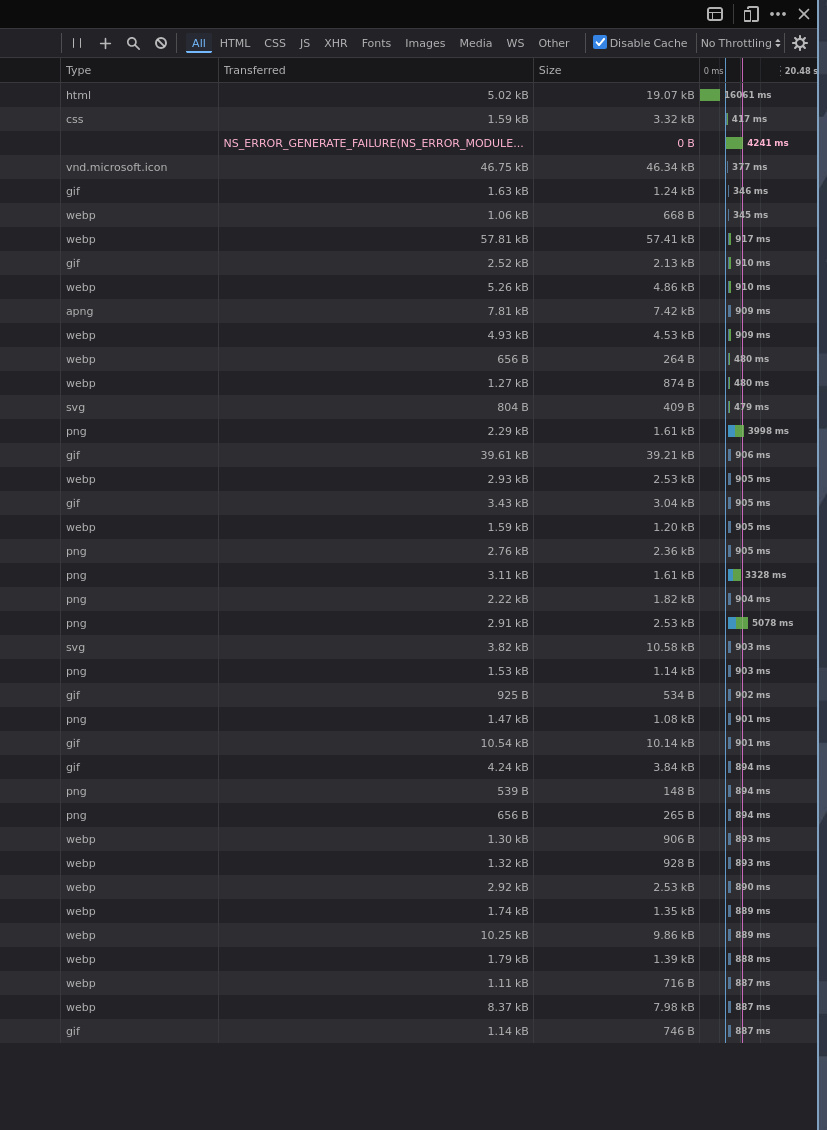
Each badge is a separate HTTP request. Font, styles, script, 67 images.
And each request is a full cycle: DNS lookup (if cold), TCP handshake, TLS handshake. Even if the image weighs a measly 200 bytes - the overhead is dozens of times larger than the image itself.
At least most people don’t hotlink and host the badges themselves.
otherwise it would be a complete fucking disaster
But even with local hosting, 67 requests is a shitton. If you have HTTP/2 and keep-alive, some of the cost gets amortized. But the initial setup still exists. And each request is a delay.
And my site is tightly optimized for 1 RTT. I can’t just casually add 67 requests.
the philosophy doesn’t allow it.
Plus, besides speed, there’s a bonus of bypassing Russian TSPU - the first packet doesn’t get caught if it fits in initcwnd.
What do we do
Obviously cramming all images into the same 1 RTT won’t work - too fat.
Inlining in HTML isn’t an option either - each badge in base64 adds ~33% to the weight, and we’d(I’d) fly past initcwnd.
But you can do it differently: collect all badges into a single CSS file as base64 and load it with ONE request.
Second request, yeah. But you can have 100 badges - still one request.
The idea: at site build time, a generator reads a config, fetches current badges (or takes local ones), converts to base64, stuffs into CSS as background-image.
How it works
The CSS is generated at site build time. Input is a config:
{
    "badges": [
      {
        "url": "https://example.com/assets/example.png",
        "href": "https://example.com",
        "alt": "example.com",
        "file": "1.png"
      },
      {
        "href": "https://test.com",
        "alt": "test.com",
        "local": "../img/test.com",
        "file": "2.png"
      }
    ]
}
Two modes:
url- fetches the badge from the specified sitelocal- takes a local file (if the badge is already downloaded and in the repo)
The generator walks the config, downloads/reads files, converts to base64, generates CSS:
.badge{display:inline-block;width:88px;height:31px;image-rendering:pixelated;image-rendering:crisp-edges}
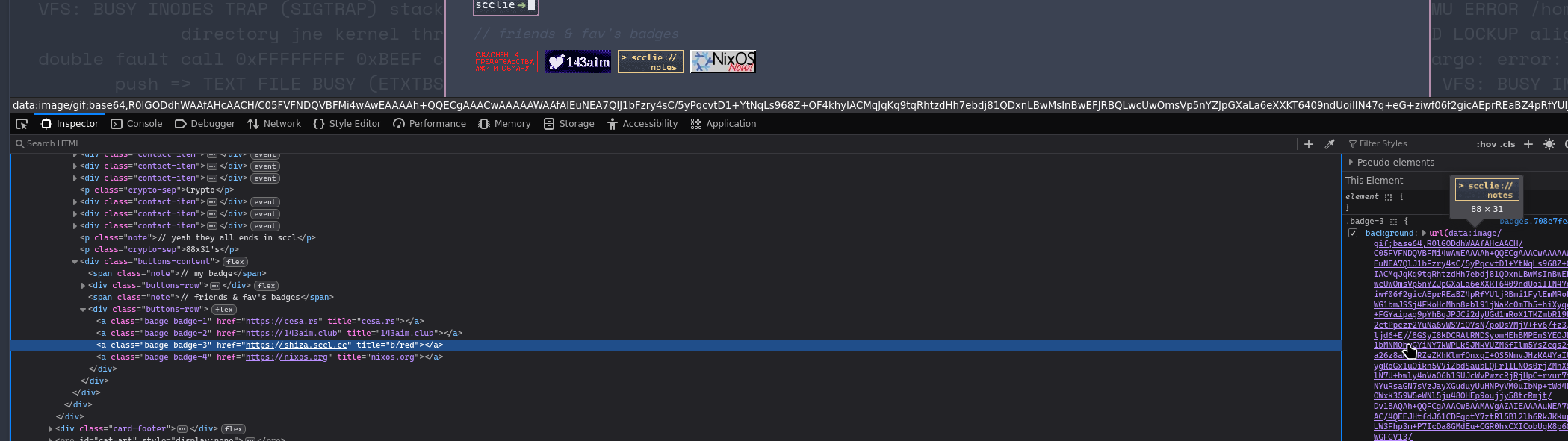
.badge-0{background:url(data:image/gif;base64,R0lGODdhWAAfAHcAACH...) no-repeat 0 0}
.badge-1{background:url(data:image/png;base64,iVBORw0KGgoAAAA...) no-repeat 0 0}
/* and so on */
Then in the HTML, instead of 67 <img> tags, we insert 67 <a class="badge badge-N"> links with a CSS background image.
Applied as a style:
The profit
Instead of 67 separate requests per badge, we get:
Main site: 1 HTTP request, 13kb gzip, 1 RTT. That’s how it was - already wrote about this.
Badges: 1 HTTP request, one CSS file with all images in base64.
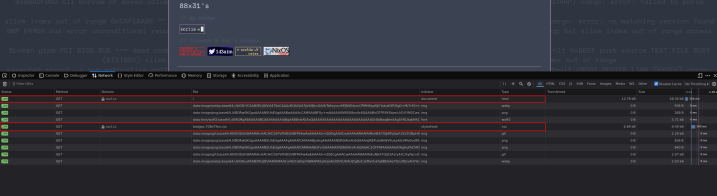
the “data:” lines are not http requests - the browser decodes base64 into images locally.
Total: TWO requests for the entire site with all badges. Instead of 68+.
If badges grow way past 10 - the CSS file might not fit in one initcwnd and go to 2 RTT. But the difference between 1 and 2 RTT isn’t dramatic when it’s not the main content. Badges in the footer - the user won’t see them right away anyway. plus I have a fallback with buttons without images
The downside: base64 adds ~33% to binary data size. For 88x31 badges (usually < 1kb) this is pocket change. But if you have a hundred badges at 5kb each - it’ll start to show.
Also the images don’t cache separately. On page refresh - badges reload together with the CSS. But CSS gets cached by the browser too, so in practice you don’t feel the difference.
In my case the benefit is clear: the site stays fast, badges are there, everything looks as it should.