Discord and the secret technology of “open file with password”
It seems surprising how many spammers are on Discord. Their sheer numbers have spawned the 1.jpg, 2.jpg, 3.jpg, 4.jpg @everyone @here meme
And then you dig into the topic and it turns out that absolutely any unauthorized file read access lets you steal someone’s session with a single token grep. No problem at all.
Not “you need to inject into the process”. Not “you need to bypass OS-level protection”. Just read a file.
What is a token?
Very roughly, in Discord:
login + password + 2fa
        ↓
Discord issues a token (hash based on some data)
        ↓
the token becomes your session
Then the client sends this token to the server with every request:
“it’s still me”
Server:
“ok, come in”
Standard scheme. That’s how OAuth2, JWT, bearer tokens work. The model itself is fine - a token instead of a password, can be revoked server-side.
The problem isn’t the token. The problem is where it sits.
Where the token is stored
Discord is built on Electron. Electron is a framework for desktop apps using HTML/CSS/JS. Basically a browser without an address bar.
Discord stores the token in Local Storage. Technically it’s a LevelDB database sitting in the user’s home directory:
~/.config/discord/Local Storage/leveldb/
Or on Windows:
%APPDATA%/discord/Local Storage/leveldb/
And the token sits there in plaintext.
Not encrypted. Not in the OS keychain. Just a string in a database. Any program running as your user can read this file.
And now the funniest part: Electron, which Discord is built on, has had a built-in safeStorage API since 2019.
It can encrypt data using OS-level mechanisms:
- macOS - Keychain Access. Protection from other users AND from other applications.
- Windows - DPAPI (Data Protection API). Encrypts with a key tied to the user account. Protection from other users.
- Linux - kwallet, gnome-libsecret, or freedesktop Secret Service. Depending on your DE.
So the tool for proper secret storage is right there in Electron, out of the box. No need to install anything separately. No need to write your own crypto. Just call safeStorage.encryptString(token).
Discord doesn’t do this.
For 6 years now.
What happens if the token is stolen?
Literally nothing interesting happens:
You take the token.
Feed it to another client.
T H A T ’ S I T …
: You’re already inside the account.
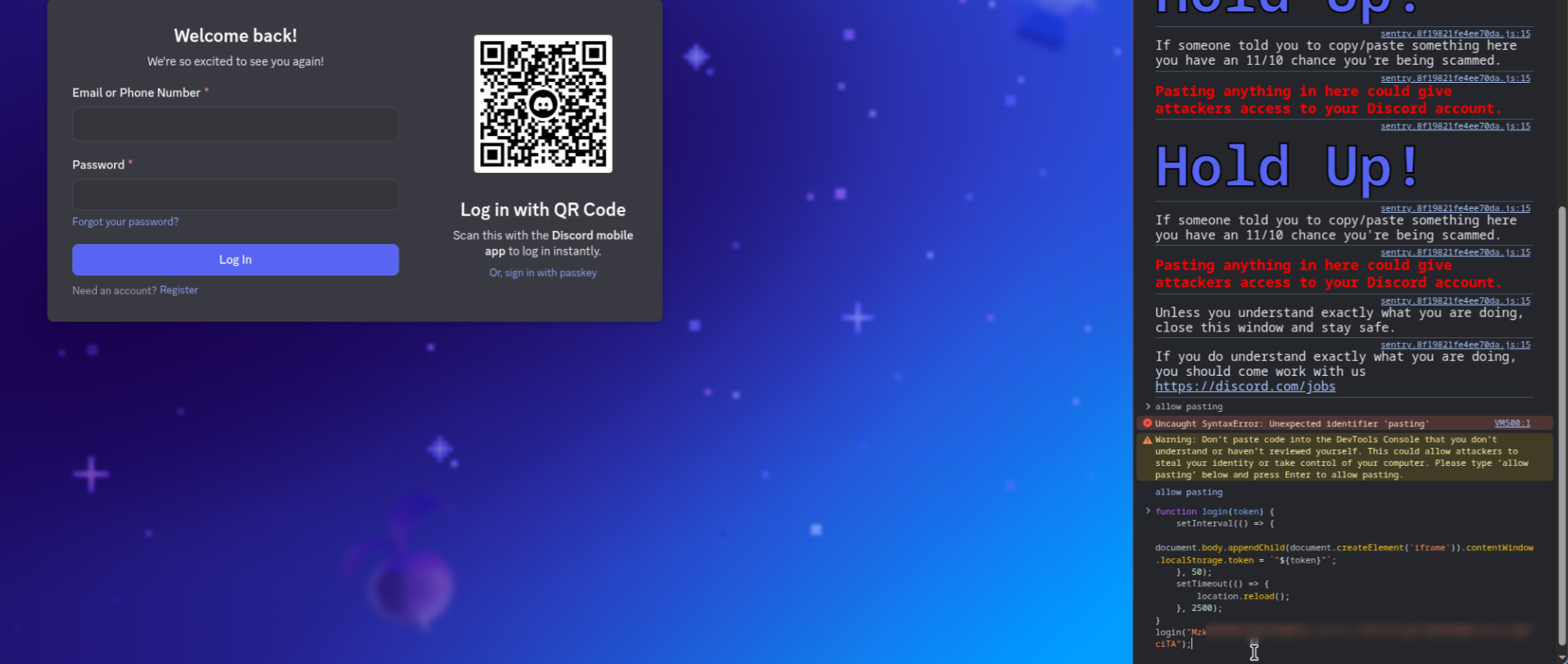
- No login.
- No password.
- No 2FA.
- No SMS.
- No passkey.
- No push notifications.
- No confirmations.
- No alerts about a new login.
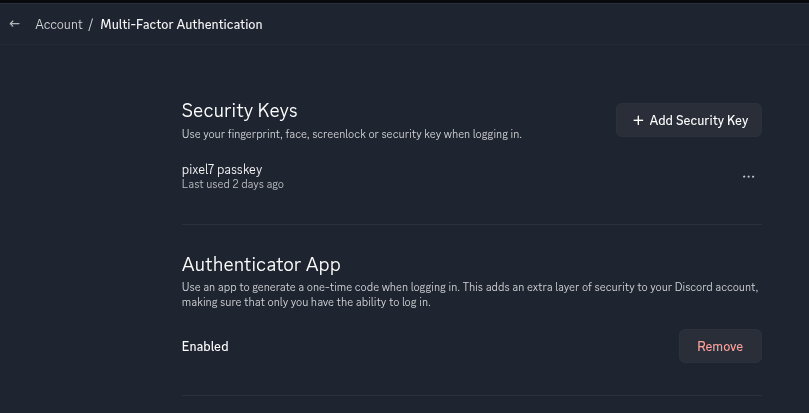
The new login isn’t even registered as new. The old session simply “moves” to a different machine.
The only thing you might notice is getting logged out of your device. And only if someone’s already logged in with that token, without leaving it for a rainy day.
Is it easy to steal?
Yes.

On Windows it works exactly the same. Any .exe you download claiming to be “game cheats” or “free nitro” can read the file and send the token to the attacker’s server.
No exploits. No zero-day vulnerabilities. Just open() on a file that Discord itself placed in the home directory.
How Discord COULD have done it
There are a fuckton of options. All standard, all industry-wide:
safeStoragein Electron - available since 2019, used by other Electron apps (Signal Desktop, 1Password, Bitwarden)- Store secrets through OS keychain directly
- Access confirmation for secrets (biometrics, master password)
- Device fingerprint + token binding to hardware
- A separate key generated on-device at first login
- Security alerts on sudden environment changes (new IP, new OS, new hardware)
- Device-based sessions with new device confirmation
Yes, all of this can also be bypassed with full access to the machine.
But between:
“read a file”
and
“inject into a process, bypass system dialogs, spoof the environment”
there’s a massive gap.
Right now the attacker only needs the most primitive access - read permissions on files in the home directory. Meaning literally any running program.
With safeStorage, the attacker would need to either inject into the Discord process, or decrypt DPAPI/Keychain (which requires privilege escalation or stealing the master password).
It doesn’t make the attack impossible. But it raises the bar from “script kiddie with grep” to “targeted attack with specific tools”.
And right now?
Right now the cost of an attack looks roughly like this:
download suspicious crap
        ↓
it reads a file
        ↓
your session is stolen: "1.jpg, 2.jpg, 3.jpg, 4.jpg @everyone @here"
And it doesn’t matter that you have 2FA. Doesn’t matter that your password is complex. The file is open to all programs running as your user.
If Discord can’t
An option - log into Discord from a dedicated user account.
So that only that user has read permissions on the session database. Barring internal exploits in the Discord app itself - the chance of anything getting stolen is minimal.
On Linux this is easy out of the box - the permission hierarchy is baked in since the system’s birth.
On Windows it’s also possible, but security isn’t as strong: permissions were bolted on as a hack only with the Vista release, and plenty of software still bypasses them.
But still better than leaving the file open to everyone, which Discord for some unfathomable reason couldn’t protect itself.

This protection layer is implemented in my NixOs config
you can check your own discord right now: go to ~/.config/discord/Local Storage/leveldb/ and run grep -r 'mfa\.[a-zA-Z0-9_-]\{20,\}' . - you’ll probably find your token.